+34 928 22 00 00
Featured posts
What is the National Ship Register?
Customs management in the Canary Islands
Type of containers used in maritime transport
Maritime transport comprises most of global trade and is carried by cargo ships. The differences between them reflect the different ways cargo can be carried and the diverse cargo that can be transported. That is the reason for all these varied types of freighter ships sailing the seas.
Container ships, bulk carriers, refrigerated cargo ships or reefers, and Ro-Ro vessels are just some of the cargo ships navigating the oceans. Below is a list of their main advantages and characteristics.
1. Bulk Carrier
Bulk carriers are designed to carry unpackaged goods. They haul large volumes of single-commodity goods such as fertilisers, grain, ore, wood, machinery, coal, cement and other raw materials.
Bulk carriers are segregated into these categories:
Capesize: The largest dry cargo ships. They are able to carry 110,000 tonnes or more of raw materials, mostly ore or grain, and represent around 9% of the world’s bulk carrier fleet.
Panamax: These ships travel through the Panama Canal and are defined by the canal’s size limits. Their cargo capacity is typically about 60,000 tonnes for Panamax vessels and nearly double for New Panamax vessels. They comprise about 19% of the bulk carrier fleet.
Handymax: These vessels have a 30 to 35 ft draught, a load capacity of around 37,000 tonnes, and represent approximately 24% of the world’s bulk carrier fleet.
Handysize: Smaller than the Handymax class, these vessels have a load capacity of around 30,000 tonnes and represent about 48% of the bulk carrier fleet.
2. Container Ships
Container ships, also called “box ships”, are large vessels designed to transport standard 10 ft, 20 ft, 40 ft, 45 ft, High Cube, Open Top, Flat Rack, Garments on Hanger or refrigerated containers.
These container ships are so widely used in international transport that they are usually highly automated, and newer models can even emit zero emissions. Nowadays, these vessels transport the vast majority of non-bulk cargo worldwide.
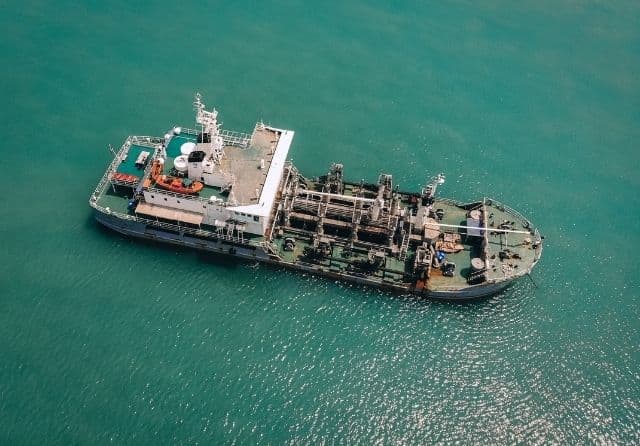
Container ships are so widely used in international transport. Freepik photo.
3. General Cargo Ships
General cargo ships are specifically focused on carrying loose-packaged cargo of all types, but they are not fitted to transport containers. A general cargo ship may have a single hold or several holds, as well as tween decks.
One of the main features of this type of vessel is that it has its own set of cranes integrated into the ship. These cranes are used to perform the loading and unloading of cargo at port.
General cargo ships are also labelled as multi-purpose vessels due to the variety of loads they can accommodate and their high level of adaptability.
4. Roll-on/Roll-off or Ro-Ro Vessels
Ro-Ro is short for “Roll-on, Roll-off”, which describes how products are loaded and discharged from the vessel. These ships carry wheeled cargo that is loaded on its own wheels or using a platform vehicle.
They typically have a set of decks interconnected via ramps or elevators, with doors located at the bow or stern of the ship. These vessels are designed to transport all kinds of vehicles, trucks, wheeled cargo and even trailers carrying containers.
The design of these vessels includes an anti-heeling system with ballast water tanks connected through cross-pipes and pumps.
5. Reefer Ships
A reefer ship is a refrigerated ship used to transport perishable cargo. This particular cargo requires a set temperature in order to arrive in safe conditions at the destination port.
The controlled temperature ranges from 12º to -30º C, and cargo capacity ranges from 100,000 to 600,000 sq ft. These ships are usually painted white to minimise heat build-up, as white reflects more light and absorbs less heat.
It is also worth noting that, due to the nature of their cargo, these vessels tend to be faster than other cargo ships.
6. Oil Tankers
Oil tankers are large vessels designed for the bulk transport of oil or oil products. Oil and gas tankers are capable of offshore berthing and can carry up to 2,000,000 barrels of oil.
7. Gas Tankers
Gas tankers are ships designed to transport liquefied gas or natural gas. The nature of this cargo demands high-technology design and machinery, which also means high construction costs.
There are two main categories of gas tankers: LNG vessels, which transport liquefied gas at temperatures nearing -170º Celsius, and LPG vessels, which transport cargo at around -50º Celsius.
The chemical load is stored in spherical tanks lined on the main deck of the vessel.
8. Chemical Tankers
Chemical tankers are designed to transport chemicals in bulk, such as phenol, gasoline or ammonia, among others. These are not the largest cargo ships, ranging from 5,000 to 35,000 or even 50,000 DWT.
Chemical tankers usually feature a double hull and stainless steel tanks to provide safer transport conditions for sensitive or hazardous cargo.
9. Livestock Carrier Ships
Livestock carrier ships are specifically designed to transport large numbers of live animals together with all their requirements for the voyage, including feeding, medication and air ventilation.
In some livestock carriers, animal pens can be installed on open decks.
10. Heavy-Lift Ships
Heavy-lift ships are designed to carry very heavy or large loads, such as industrial machinery, jet bridges or wind turbines.
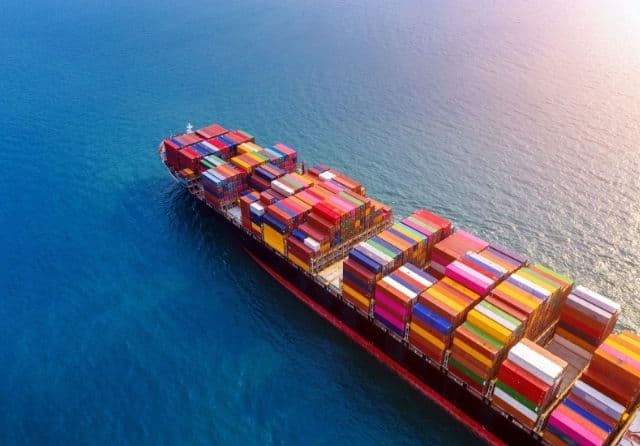
Suisca Group we are ready to provide all solutions and all answers to your every need. Freepik photo.
When we talk about the needs of the different types of cargo ships and the needs of your business, at Suisca Group we are ready to provide all solutions and all answers to your every need.
With a trustworthy service, a 24-hour committed team and more than 30 years of experience, Suisca Group is your maritime partner wherever you are. Get in touch with us and our team of specialists will help you find the solution you need.